
The heart of the work
Not everything we need to grieve has died.
Some of the deepest grief comes from relationships that are still here, but can no longer be what we hoped they would become. It can live in the distance between you and a parent, in the family that no longer feels like home, or in the painful recognition that repair or reconciliation may no longer be possible.
Making room for this grief can also make room for something new: a clearer sense of what you need, deeper trust in your own experience, and relationships where you don't have to leave parts of yourself behind in order to belong.
Read: The Grief of Never Feeling Fully Known by a Parent
There is a way forward.
You don't have to have all the answers to begin. Understanding what you've lived through, grieving what could not be, and learning to trust yourself again can become the beginning of a different relationship with yourself, with others, and with the life ahead of you.

Grief & Loss
For the losses that don't always have a name. The relationships that changed, the future you imagined, the family you needed, and the parts of yourself you may have lost along the way.

Family & Estrangement
For making sense of complicated family relationships, painful distance, and estrangement—with room for love, anger, relief, guilt, and the possibility that more than one thing can be true.

Belonging & Identity
For discovering who you are when you no longer have to shape yourself around who others need you to be—and building a life where belonging doesn't require leaving yourself behind.
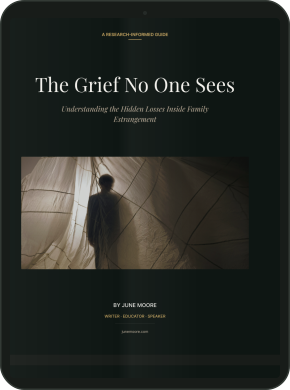
A FREE GUIDE
The Grief No One Sees
Understanding the hidden losses inside family estrangement.
When a relationship ends without a death, the grief can be difficult to explain—even to yourself. This free guide offers language for what you may be experiencing and a compassionate place to begin making sense of the losses that often go unseen.
 18 guided reflection prompts
Explore the Guide
See what's inside, then request your complimentary copy.
VIEW THE FREE GUIDE →Free PDF guide · 18 guided reflection prompts
Words for what you've been carrying.
Essays and reflections on grief, family, belonging, and becoming—written to help you understand what you're experiencing, put language to what has been difficult to name, and imagine what might be possible from here.
You don't have to navigate this alone.
There are different ways to find support, connection, and language for what you're moving through. Explore resources, conversations, and experiences created to help you feel less alone—and more connected to yourself and what comes next.

Resources
Thoughtful guides and practical tools to help you understand what you're experiencing, care for yourself through difficult relationships and loss, and begin finding your own way forward.

Groups & Workshops
Small-group experiences for exploring grief, family relationships, identity, and belonging alongside others who understand how complicated this work can be.

Speaking
Thoughtful, research-informed conversations about grief, family relationships, belonging, and what it means to find your way forward when the relationships that shaped you can no longer remain the same.

COMING MARCH 2027
Counseling
Beginning March 2027, I will offer counseling services as a graduate clinical mental health counseling intern under clinical supervision. Location and appointment details will be shared closer to the start date.
SPEAKING
Conversations that make room for what we don't always know how to talk about.
I speak and facilitate conversations about the experiences that shape us but often remain difficult to name—from family estrangement and ambiguous grief to belonging, identity, and the complicated work of becoming more fully ourselves.
My approach brings research into conversation with lived experience, creating space for complexity, curiosity, and the possibility that understanding something differently can change how we relate to ourselves and one another.
SPEAKING INQUIRIES →POTENTIAL CONVERSATIONS
- Family Estrangement & Ambiguous Grief
- Grieving Relationships That Still Exist
- Belonging Without Self-Abandonment
- Identity, Loss & Becoming
- When Repair Isn't Possible
- Finding Our Way Back to Ourselves


ABOUT JUNE
What if healing isn't something we have to keep chasing?
For years, I believed that if I could understand enough, find the right framework, do enough healing, or finally repair the relationships that hurt, I would eventually arrive somewhere on the other side of the pain.
My work has grown from questioning that relentless search—and becoming increasingly interested in what happens when we stop trying to solve our grief and begin listening to what it needs from us.
"Sometimes what we have been searching for is not another answer. It is the space to grieve what we needed and did not receive, to accept the limits of relationships we cannot change, and to turn toward the parts of ourselves that have been waiting for our attention."
I'm a writer, educator, researcher, and counselor-in-training whose work explores grief, complicated family relationships, identity, and belonging. I bring together psychological research, relational and attachment perspectives, grief and loss, embodied and transpersonal ways of knowing, and years of work in behavioral research, education, and human-centered program design.
I'm less interested in giving people another framework for what is "wrong" with them than I am in creating space for a different kind of healing—one that makes room for grief, acceptance, self-trust, meaning, and ways of knowing that cannot always be reached through analysis alone.
I believe we can understand the people who shaped us without abandoning our own experience. We can grieve what we did not receive without reducing an entire relationship to what was missing. And we can build lives and relationships that make room for more of who we are becoming.
MORE ABOUT JUNE →